
For much of my career, my work has focused on one question: How do we make schools safer in a way that actually works?
Over the years, I’ve had the opportunity to work with thousands of school districts across the country large and small, urban and rural, well-resourced and under-resourced. What they all have in common is thoughtful, committed educators doing their best to protect students and staff, while juggling limited time, funding, and expertise. And I’ve seen how hard it is to get school safety “right” in an environment never intended to operate like a hardened facility.
There’s one lesson that stands out: schools are not failing at safety because they don’t care or aren’t trying. Schools struggle because safety has too often been treated as a collection of individual fixes rather than a cohesive system of aligned, coordinated efforts.
What We’ve Learned the Hard Way: The Cost of Reactive Security
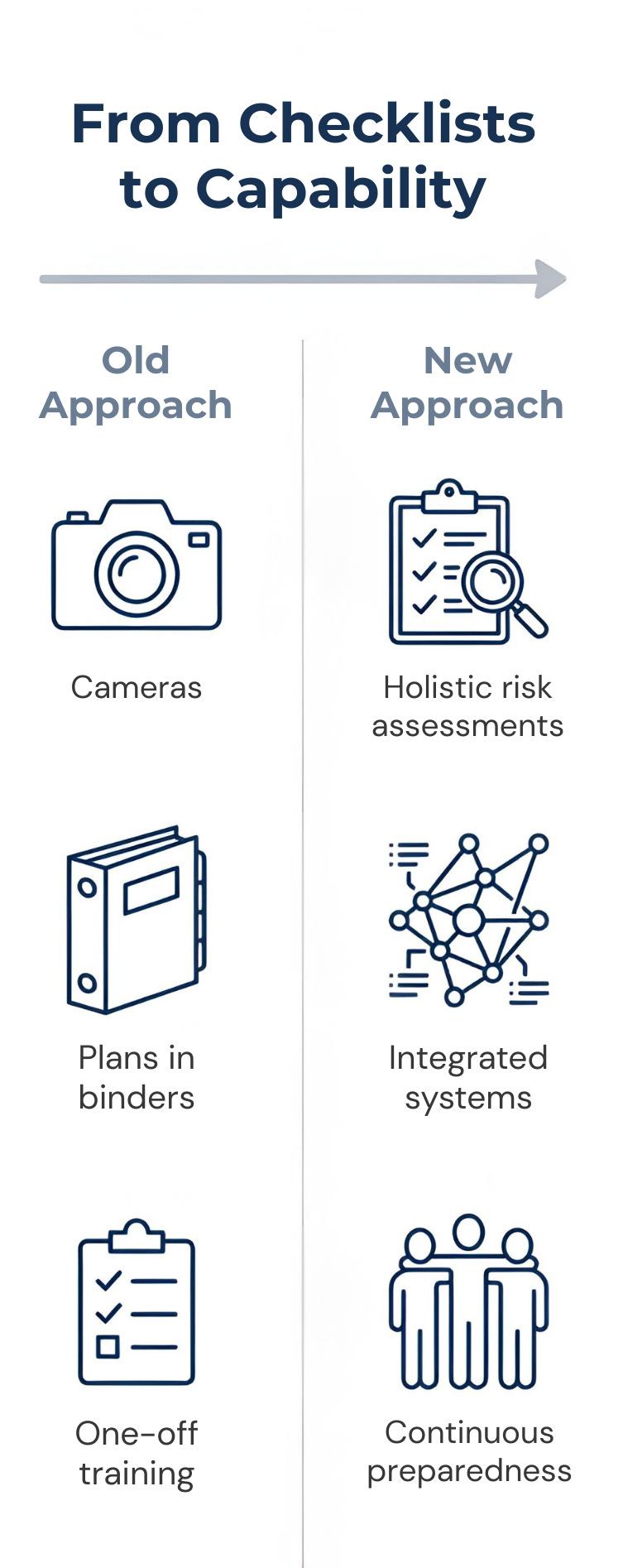
For many years, K-12 safety and security efforts have been largely reactive. A high-profile tragedy occurs, funding becomes available, and schools rush to implement solutions – sometimes without a clear assessment of their unique risks and needs or a long-term plan. They add cameras. Upgrade access control. Schedule training. While each of these actions can be useful, too often they happen in isolation.
The result is a patchwork approach, systems don’t talk to one another, plans exist on paper but aren’t exercised, and technology looks impressive but doesn’t meaningfully improve readiness when it matters most.
Schools are routinely expected to make complex security decisions without sufficient resources or the expertise of security organizations. Superintendents and principals carry responsibility for safety, but it’s rarely their only or even primary role. Staff turnover erodes institutional knowledge. New threats emerge faster than guidance can keep up. Well-intentioned leaders are forced to make decisions without consistent technical support.
Perhaps most importantly, physical security, cybersecurity, and preparedness are treated as separate domains. Cybersecurity lives with IT. Physical security lives with facilities. Emergency planning lives in a binder. However, real-world threats don’t respect those boundaries. Disruptions today move quickly across systems, and our defenses must have the same capabilities
2026 and Beyond: Compliance to Capability
As 2026 begins, there is reason for cautious optimism. Across the country, I see schools and districts beginning to shift from a compliance mindset toward a capability mindset. The question is no longer ”Do we have a system or plan?” Instead, it’s becoming, “Does it work together, and does it reflect our unique risks?”
This shift requires schools to clearly understand their own environment and make risk-informed decisions based on that reality. Not every school faces the same threats, and not every solution delivers the same value in every context. Effective security begins with understanding what matters most in your context, where vulnerabilities exist, and what the consequences of disruption would be, and aligning investments accordingly.
We must acknowledge that school safety is not the responsibility of any single role or organization. School leaders set direction, but they cannot do this work alone. Community partners, public safety agencies, technology providers, educators, staff, parents, and students must all play a part. When these groups operate in isolation, gaps form, but when they are aligned, safety efforts become more durable and more effective.
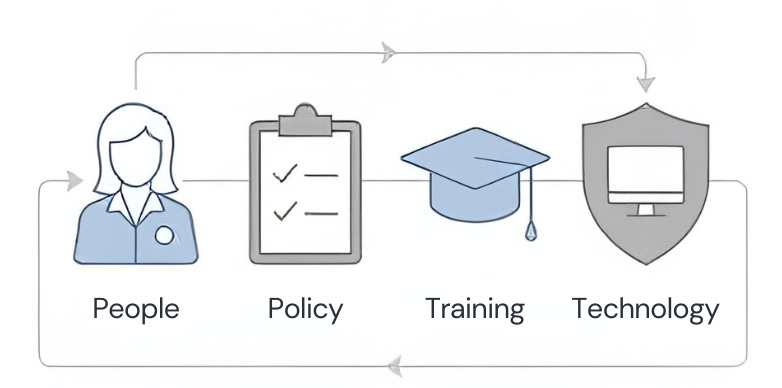
Convergence is no longer optional. Cyber and physical systems are increasingly intertwined, as are the people who depend upon them. Information sharing, incident response, and recovery depend on coordination across people, technology, and policy. Preparedness cannot be an afterthought; it must be exercised, evaluated, and improved over time.
Finally, school safety must be understood as a leadership responsibility, not just a security function. Boards, superintendents, and public officials do not need to be security experts; however, they must understand risk, tradeoffs, and priorities well enough to make informed decisions and set clear expectations across the entire community.
Beyond Schools: A Public-Sector Imperative
Schools don’t operate in isolation. They sit within broader communities, including local government, public safety agencies, healthcare systems, and critical infrastructure. Many of the challenges seen in K-12 security, fragmented planning, disconnected systems, and resource constraints, also exist across the public sector.
The good news: the lessons learned in schools are transferable. Risk-based planning, integrated preparedness, and disciplined prioritization improve resilience, not just for school districts, but for entire communities.
How We’ll Know We’re Getting it Right
In 2026, safer schools and stronger public institutions won’t be defined by how much technology they’ve installed. Instead, they’ll be measured by how well they understand their risks, how clearly responsibilities are assigned, how strong the connections and support are across students, staff, and leadership, and how well people respond when something goes wrong.
Success looks like systems that work together, plans that are practiced, and leaders who can explain not just what they’ve invested in but why.
School safety, and, more broadly, public-sector security, is not a destination. It’s an ongoing commitment to our young people and communities requiring humility, learning, and partnership. The work ahead isn’t about doing more. It’s about doing what matters most better.
If you found this helpful, consider subscribing to The Safer Schools Report for weekly insights on leadership, preparedness, and prevention in K-12.